Electrical systems are the part of van life most people put off learning until they're already living with a dead battery. Here's the groundwork to understand before you start bolting anything down.
Why Electrical Planning Comes Before Everything Else
A van build usually starts with insulation, flooring, or a bed platform — the visible, satisfying parts. But electrical is the system that everything else depends on: your fridge, your lights, your water pump, your laptop charger. Getting it right the first time saves you from ripping out walls later to fix wiring that can't keep up.
The good news is that van electrical systems are more approachable than they look. Most builds boil down to a handful of decisions repeated at different scales.
The Main Components of a Van Electrical System
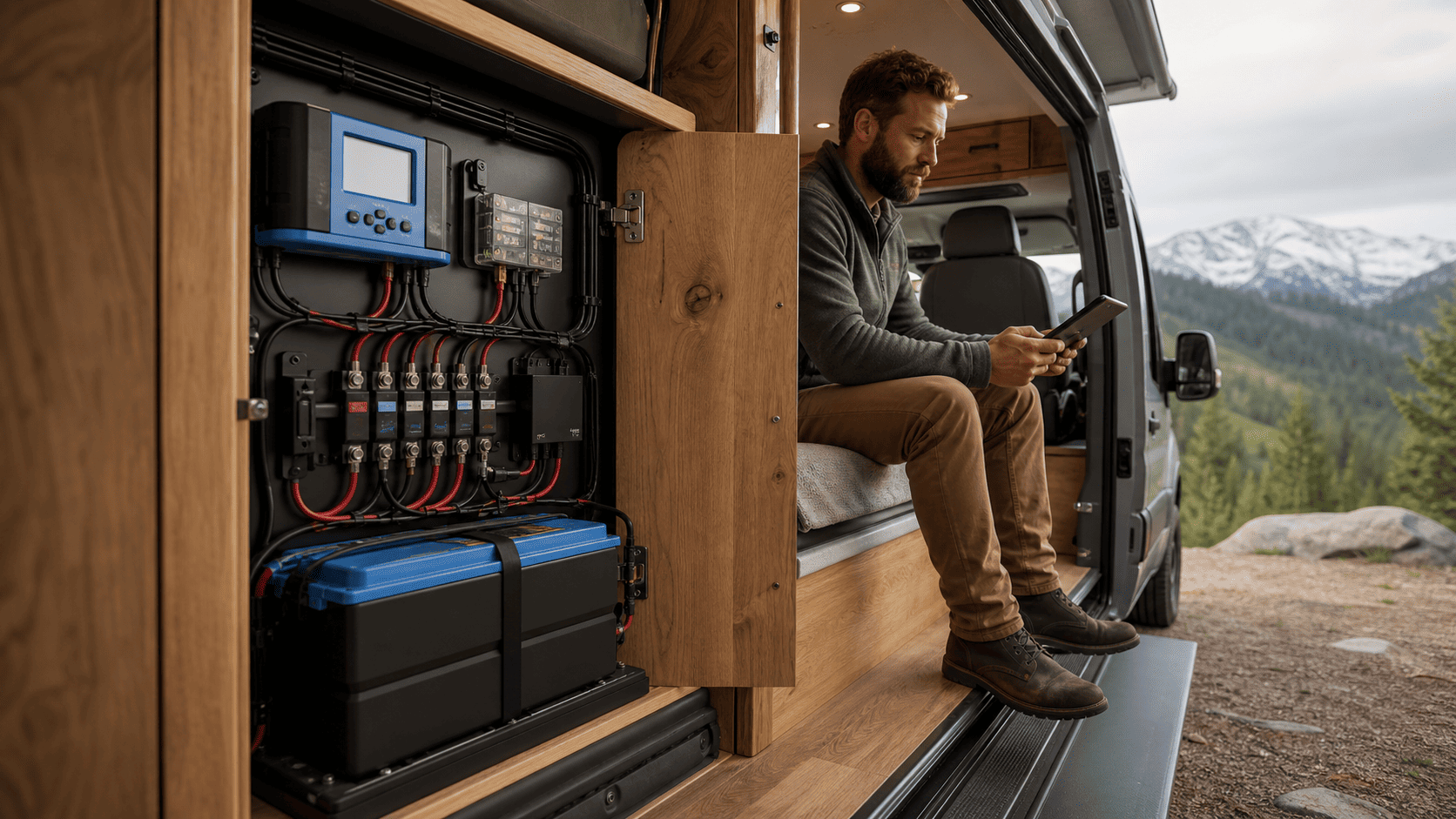
A typical van power setup includes:
- House battery bank — separate from your vehicle's starter battery, this powers everything in the living space.
- DC-DC charger — charges the house battery from your alternator while driving, without draining your starter battery.
- Solar panels and charge controller — top up the battery while parked, especially useful on multi-day stays.
- Inverter — converts battery power to AC for laptops, kitchen appliances, or anything that needs a standard wall-outlet plug.
- Fuse box and wiring — distributes power safely to lights, fans, pumps, and outlets throughout the van.
Not every van needs all of these. A simple weekend setup might just be a portable power station and a couple of USB fans, while a full-time rig usually has all five working together.
1200 × 700px
A common wiring layout for a mid-size van electrical system.
Amp-Hours vs. Watt-Hours: Why Both Numbers Show Up
Batteries are usually rated in amp-hours (Ah), while the devices you run are usually rated in watts. To compare them, you need to convert one to the other, and the link between them is voltage.
Watt-hours = amp-hours × voltage. So a 100Ah battery at 12 volts stores roughly 1,200 watt-hours. That number is what you actually want when figuring out how long your battery will last, because it lets you compare directly against how many watt-hours your devices consume over a day.
Most lithium batteries shouldn't be discharged all the way to zero regularly. Many builders plan around 80% usable capacity to protect battery lifespan, so a "100Ah" battery often behaves more like 80Ah in daily use.
The Three Ways to Charge a Van Battery
Most van builds rely on some combination of three charging sources:
- Driving — a DC-DC charger pulls power from the alternator while the engine runs, which is often the fastest way to recharge on travel days.
- Solar — passive and free once installed, but dependent on weather, season, and how much roof space you have.
- Shore power — plugging into a campground or house outlet through a built-in charger, useful for topping off overnight at a paid site.
Full-time van lifers often lean on a mix of driving and solar, since it lets them stay off-grid indefinitely without needing to seek out plug-in sites.
A Simple Way to Plan Your Own Build
Before buying any components, it helps to list out everything you plan to run electrically and roughly how many hours a day you'll use each one. Multiply each device's wattage by its hours of use to get daily watt-hours, then add it all up. That total becomes the target your battery and charging sources need to cover.
It's normal for this number to be higher than expected the first time you calculate it — refrigerators, in particular, run far more often than people assume. Building in some headroom above your calculated need makes the system far more livable day to day.