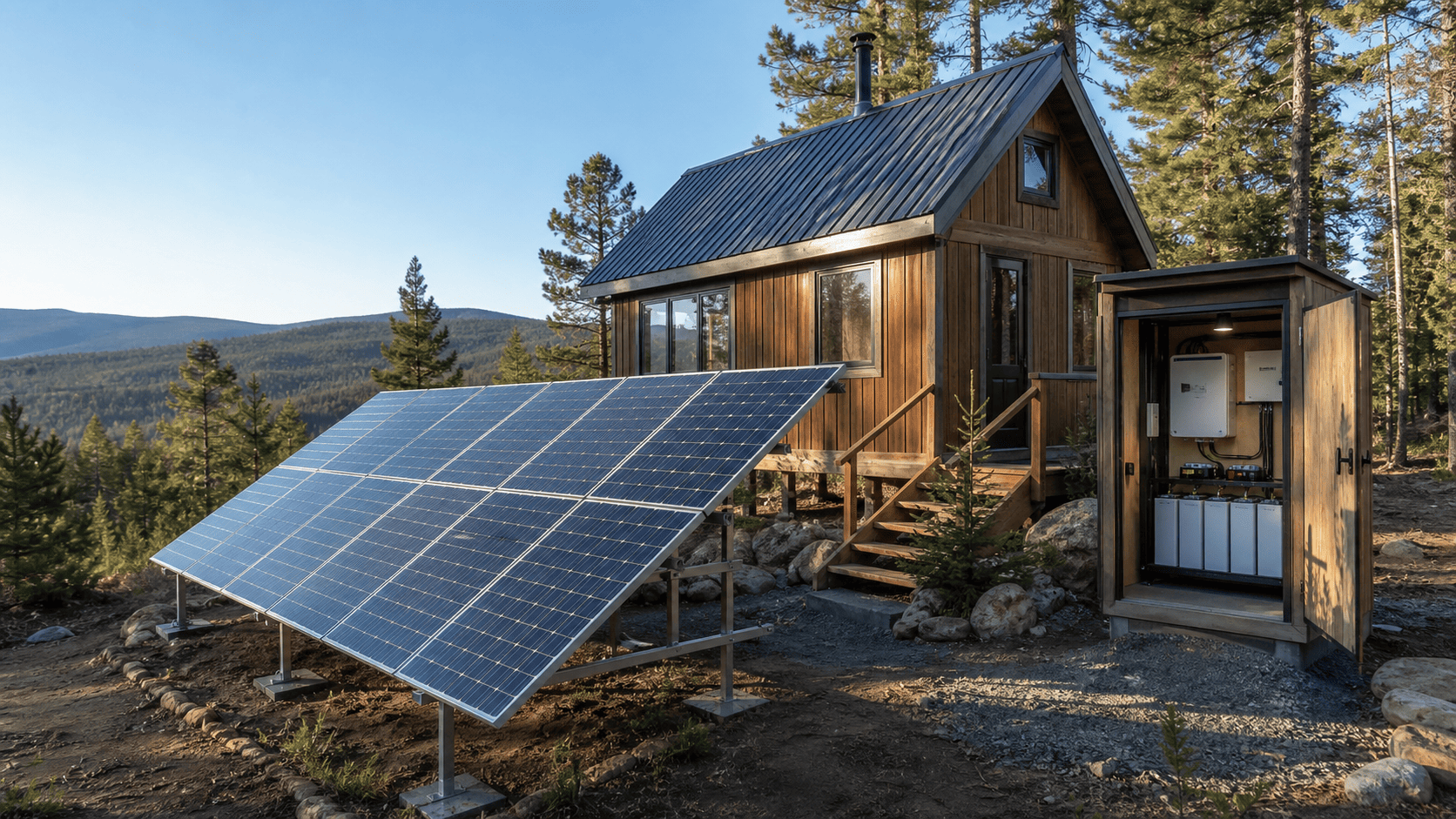
If you've ever wondered what actually happens between a solar panel on your roof and a light turning on inside your rig, this guide walks through the whole chain — no jargon, no sales pitch.
What "Off-Grid Solar" Actually Means
"Off-grid" simply means your power system isn't connected to the utility grid at all. Instead of pulling electricity from a wall outlet, you're generating it yourself, storing it in a battery, and drawing it back out whenever you need it. This is different from a grid-tied home solar setup, which sends excess power back to the utility company and doesn't need batteries to function day to day.
For van dwellers, cabin owners, and weekend campers, off-grid solar is less about environmental ideals and more about practicality: it lets you run lights, charge devices, and keep a fridge cold without a generator running all night or a extension cord back to civilization.
The Four Core Components of Any System
Every off-grid solar setup, no matter how big or small, is built from the same four pieces working together:
- Solar panels — capture sunlight and convert it into DC electricity.
- Charge controller — regulates the power coming from the panels so it doesn't overcharge or damage the battery.
- Battery bank — stores the electricity for use when the sun isn't out.
- Inverter — converts the battery's DC power into the AC power that most household appliances expect.
Some systems skip the inverter entirely if everything you're running — lights, fans, USB chargers — can run directly on DC power. That's common in smaller van and camping setups.
1200 × 700px
A simplified flow of how power moves through a typical off-grid solar system.
How Solar Panels Turn Sunlight Into Electricity
Solar panels are made of photovoltaic (PV) cells, usually silicon-based. When sunlight hits these cells, it knocks electrons loose, and that movement of electrons is what creates an electrical current. The panel doesn't store any of that energy — it just produces it in real time, which is why the battery bank matters so much.
Panel output is measured in watts, and that number represents the maximum the panel can produce under ideal, direct sunlight. Cloud cover, panel angle, shading, and time of day all reduce real-world output, sometimes significantly. A 200-watt panel rarely produces a full 200 watts for more than a few hours around midday.
Panel wattage is a lab-tested maximum, not a guaranteed daily output. When sizing a system, it's more useful to estimate average daily sun hours for your location than to assume peak wattage all day long.
A Quick Way to Think About Sizing
Rather than starting with "how big a panel do I need," it's usually more useful to start with "how much power do I use in a day." Add up the watt-hours of everything you plan to run — lights, a laptop, a small fridge, a fan — over a 24-hour period. That total tells you roughly how much your battery needs to store and how much your panels need to replace each day.
As a rough rule of thumb, a system needs to generate at least as much energy on an average day as you plan to consume, with some buffer for cloudy days and battery inefficiency. Most people undersize their first system and learn this lesson the hard way after a few overcast days in a row.
Common Mistakes First-Timers Make
A few patterns show up again and again in off-grid solar setups, especially first builds:
- Ignoring shade — even partial shading on one panel can drastically cut output across an entire string, depending on how the system is wired.
- Undersizing the battery — panels can only charge during daylight, so the battery needs to comfortably cover overnight and low-sun periods.
- Skipping the charge controller math — pairing the wrong controller type or size with your panel and battery voltage can limit performance or cause damage.
- Forgetting about temperature — both panels and batteries lose efficiency in extreme heat or cold, which matters if you're camping in varied climates.
None of these are complicated to avoid once you know to look for them — they're just easy to miss the first time you're piecing a system together.